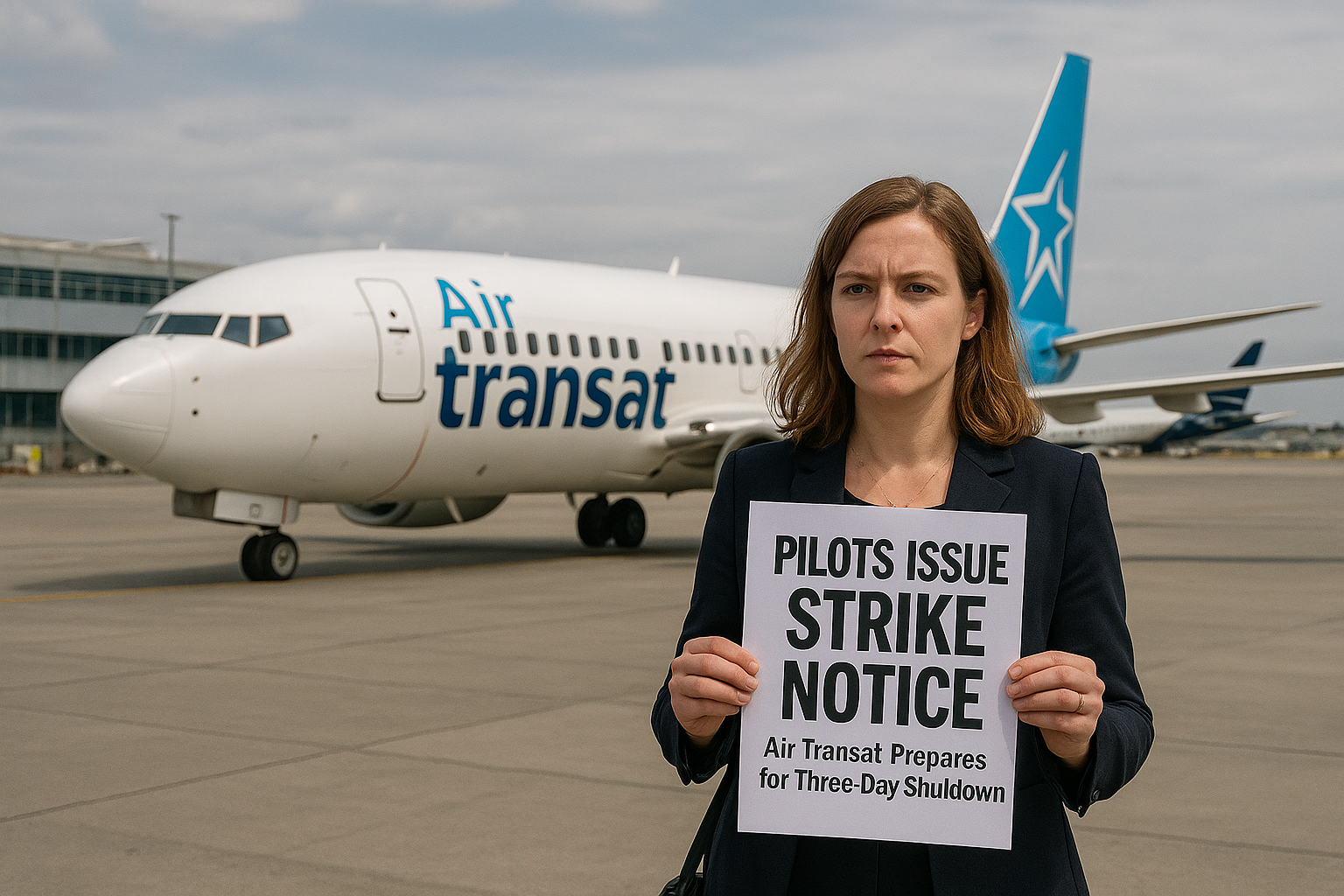
Mounting Uncertainty as Contract Talks Stall
Air Transat is bracing for a full-scale operational halt, announcing it will phase out all flights over three days after receiving a 72-hour strike notice from the union representing its pilots. The development, revealed early Sunday morning, immediately sent ripples of concern through travellers already in transit or preparing for holiday departures.
The Montreal-based carrier responded swiftly, calling the notice “premature” and emphasizing that progress has been made in negotiations — though not enough to avert the possibility of a work stoppage as early as Wednesday at 3 a.m. ET. The airline maintains there is still room for a breakthrough, but the countdown has begun.
The impending shutdown raises an uneasy question for many passengers: Will they be able to return home on time?
A Gradual Halt to Protect Travellers
Step-by-Step Suspension Plan
In its statement, Air Transat explained that the strike notice triggers an immediate obligation to roll out its contingency plan. The airline said it must take “proactive” steps to avoid a chaotic disruption if pilots walk off the job mid-operation.
That plan includes:
-
Beginning flight suspensions Monday
-
Implementing a full shutdown on Tuesday
-
Repatriating passengers before Wednesday’s strike deadline
The goal, the company said, is to ensure no one is stranded abroad. The airline intends to bring passengers back to their original departure points while there is still time to manoeuvre.
This measured wind-down reflects lessons learned across the industry. Sudden strikes can leave thousands stuck in terminals, on islands, or in cities far from home. Air Transat insists it wants an orderly process — even if the circumstances are far from ideal.
Pilots Say Negotiations Have Stalled
The Air Line Pilots Association, International (ALPA), which represents the airline’s pilots, said the strike notice was issued only after months of frustrating talks.
Capt. Bradley Small, chair of the Air Transat Master Executive Council, stated that the airline left the union with “no choice.”
He described negotiations as “unproductive,” insisting that a strike will occur unless substantial progress is made before Wednesday. Still, he noted, there is time to avoid escalation if management delivers concrete improvements.
“If we cannot reach an agreement, management will be responsible for every cancelled flight and stranded passenger,” Small said.
A Network Touching 33 Countries
A Global Footprint at Risk
Air Transat serves 10 domestic routes and 63 international destinations — stretching across Europe, the Caribbean, North Africa, South America, and the U.S. East Coast.
This geographic spread amplifies the stakes. A strike doesn’t only affect weekend leisure trips. It affects business travellers, exchange students, family visits, winter sun seekers, and, in many cases, travellers already abroad.
The complexity of worldwide operations makes repatriation essential. A passenger stuck in Lisbon, Punta Cana, or Marrakech can’t simply catch a quick alternative domestic carrier home.
As one industry observer joked recently, “An airline strike is like missing the last train of the night — only the station is an ocean away.”
Travellers Voice Anxiety as Departure Dates Loom
Stress Mounts at Canada’s Busiest Airport
At Toronto Pearson International Airport, tension was visible as would-be vacationers tried to weigh excitement against uncertainty.
Some were headed out on long-planned trips. Others were already recalculating what a mid-vacation strike might mean.
Clara Yoon, preparing to fly to the Dominican Republic, said she felt “scared and stressed” about her return plans next week.
“I’m afraid I won’t be able to come back home,” Yoon told CBC News Network.
She said the timing of the announcement — just as she and her travel companions were about to leave — made the situation even more frustrating.
Her reaction echoes a familiar sentiment among travellers: nothing derails vacation anticipation quite like the question of whether you’ll be able to get back.
A Fictional Glimpse Into Travellers’ Concerns
One passenger, rushing between check-in counters with a sun hat dangling from her backpack, shared a fictionalized anecdote that captures the mood:
“I told my husband, ‘If we get stuck, I hope you love the Caribbean enough to live there.’ He laughed. I didn’t.”
The comment landed with humour but also truth. Many travellers are juggling work commitments, childcare, or medical appointments. A surprise extension abroad sounds idyllic only until reality intervenes.
The Airline’s Position: Offers Already on the Table
Air Transat Argues It Has Been Negotiating in Good Faith
The airline has emphasized that it has made “generous” proposals and believes the two sides have moved closer to an agreement in recent days.
Still, the decision to prepare for an immediate shutdown suggests the company is taking the union’s notice seriously. The strategic suspension plan demonstrates a desire to minimize reputational damage — something no carrier wants during a busy travel season.
Air Transat maintains it hopes the coming hours will be enough to avoid a strike entirely. Each side insists resolution is still possible. Yet both are preparing for the worst.
What Comes Next?
A Narrow Window for a Deal
With the strike set to begin early Wednesday morning, the pressure is building. A successful negotiation within the next two days could restore normal operations and ease passengers’ concerns.
If no agreement emerges, air travel across multiple continents may be disrupted for an unknown period. Repatriated passengers could find themselves rebooking with crowded competitors or waiting indefinitely.
The uncertainty is creating a delicate tension: quiet optimism from both sides, and jittery anticipation from those who simply want to travel.
Conclusion: A Pivotal Moment for Canada’s Third-Largest Airline
Air Transat is confronting a critical test as pilot negotiations reach a breaking point. The coming days will determine whether the company can maintain stability or whether its operations will grind to a halt under one of the most consequential labour disputes it has faced in years.
For travellers, the situation is a reminder of how quickly vacation plans — or essential journeys — can be upended by events far beyond their control.
Leave a Reply