Introduction: A Defining Moment for Canada’s Economic Future
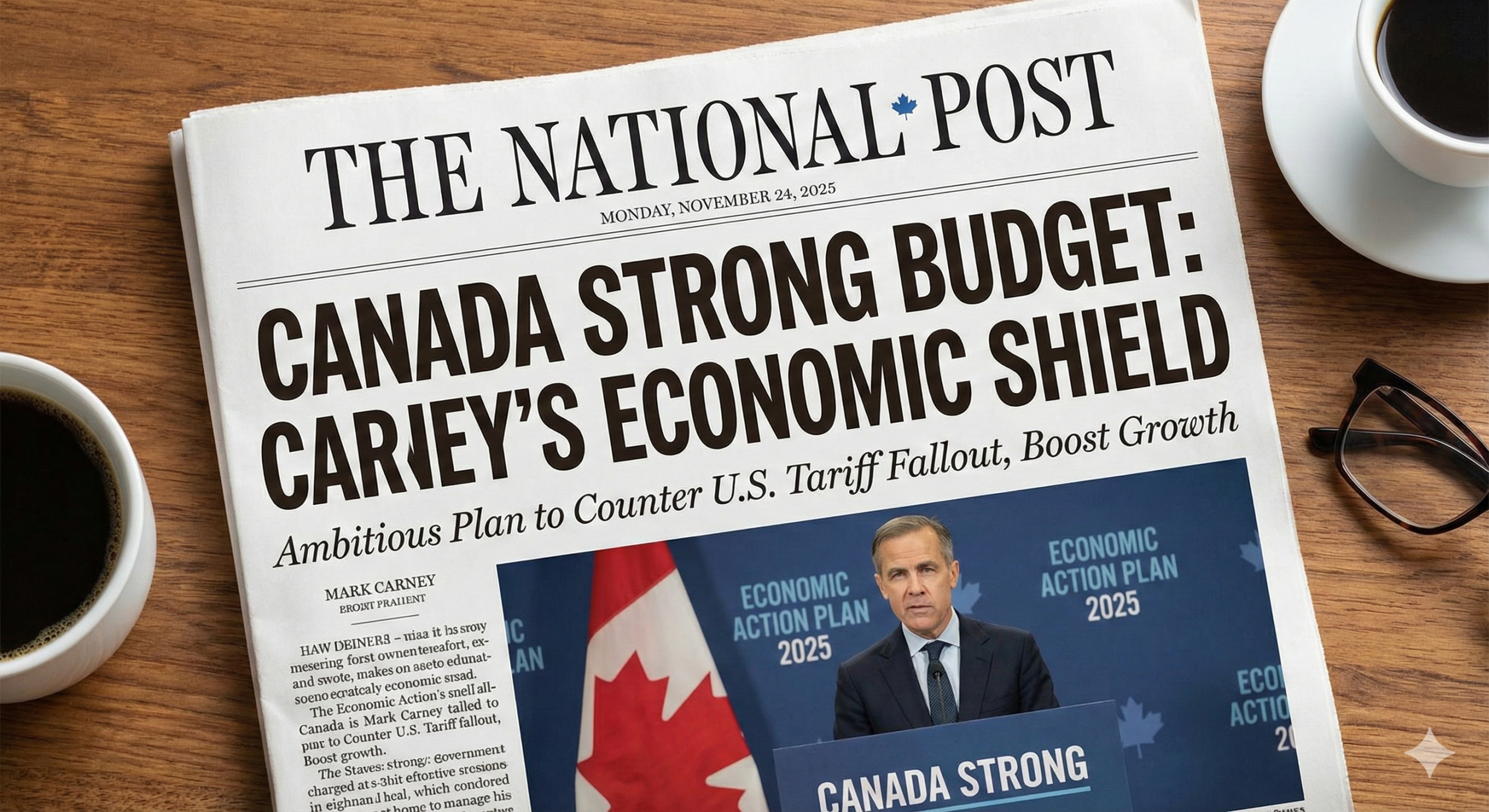
Canada’s newly appointed Prime Minister Mark Carney has launched an expansive federal budget designed to protect the national economy from the escalating impact of U.S. tariffs and global trade instability. Presented earlier this week, the sweeping $580 billion fiscal plan outlines a bold strategy aimed at strengthening Canada’s industrial backbone, modernising infrastructure, enhancing defence capacity, and supporting long-term national resilience.
As Carney and Finance Minister François-Philippe Champagne embark on a nationwide tour to explain the budget to Canadians, the political realities remain challenging. Leading a minority government, Carney must secure support or strategic abstentions from opposition parties to avoid triggering a snap election during the holiday season. Despite resistance from conservative factions, the government insists the budget represents a critical turning point for Canada in a rapidly transforming global landscape.
Mark Carney’s Vision: Responding to a Global Economic Crossroads
Addressing media and stakeholders following the budget’s unveiling, Carney described the current period as a “hinge moment” for the nation, warning that indecision could leave Canada vulnerable to economic shocks. He stressed that global trade systems are undergoing fundamental restructuring, exacerbated by technological acceleration, geopolitical tensions, and evolving tariff regimes.
The Impact of U.S. Tariffs on Canada
According to government estimates, punitive U.S. tariffs and the broader uncertainty surrounding them could cost Canada approximately 1.8 percent of its Gross Domestic Product. This decline translates to a potential loss of $50 billion and an economic burden of roughly $1,300 per Canadian citizen.
Carney emphasised that while Canada cannot dictate decisions made in Washington, it retains full authority over its domestic economic strategy. By investing strategically and strengthening local industries, he asserted that Canada could recover these losses and exceed previous growth levels.
The ‘Canada Strong’ Budget: Key Spending Priorities
The budget, branded under the theme “Canada Strong,” introduces $141 billion in new spending over the next five years. This investment is directed toward revitalising critical sectors while positioning Canada for sustainable long-term growth.
Defence Spending Expansion
One of the most significant allocations is the nearly $82 billion earmarked for defence initiatives. This funding aims to modernise military capabilities, enhance national security, and move Canada closer to meeting NATO’s recommended defence spending benchmark of five percent of GDP.
The government argues that this expanded defence budget is essential in response to global instability and shifting security dynamics.
Infrastructure and Nation-Building Projects
An additional $51 billion has been designated for large-scale infrastructure development. Planned projects include high-speed rail corridors, modernised ports, renewable energy facilities, and carbon capture and storage systems. These initiatives are intended not only to create jobs but also to strengthen trade networks and reduce dependency on external supply chains.
Boosting Canadian Industries and Housing
The budget also includes increased funding for housing development and a renewed commitment to domestic procurement through a “Buy Canadian” strategy. This approach is designed to stimulate local production, reduce reliance on imports, and create more affordable housing across urban centres.
Government Strategy: Balancing Investment and Fiscal Discipline
To counterbalance the surge in government spending, the Carney administration plans to implement $60 billion in cost-saving measures over the same five-year period. These reductions will be achieved through efficiency reforms, departmental restructuring, and significant downsizing of the federal workforce.
Federal Job Reductions
Nearly 40,000 federal positions are expected to be phased out, primarily through voluntary buyouts and natural attrition. While the government portrays this move as a responsible fiscal adjustment, critics argue it may weaken public services and reduce government operational capac
Leave a Reply