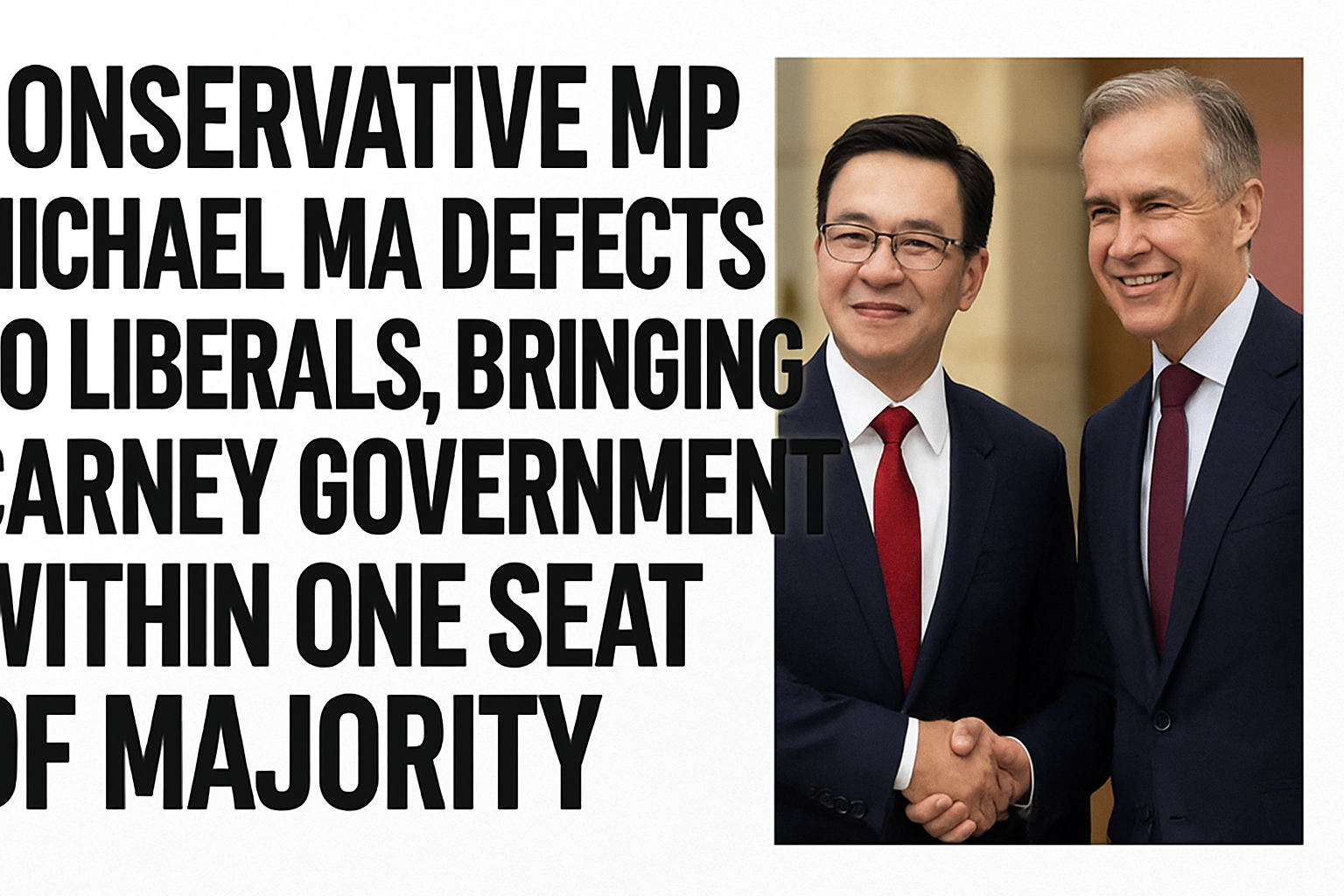
A Major Political Shift Reshapes the Balance of Power in Ottawa
In a move that has sent shockwaves through Parliament Hill and significantly altered the federal political landscape, Conservative MP Michael Ma has crossed the floor to join the governing Liberal Party. The decision, announced Thursday evening, positions Prime Minister Mark Carney’s minority government within striking distance of a full majority—just one seat away.
Ma, who represents the Ontario riding of Markham–Unionville, entered federal politics only this year. His defection marks the second high-profile Conservative crossing in recent months, accelerating a period of intense political recalibration in Ottawa and reigniting debates over party loyalty, leadership direction, and the evolving priorities of Canadian voters.
Ma Cites “Unity” and “Decisive Action” as Motivations
A Personal and Political Turning Point
In his written statement announcing the move, Ma described a period of deep reflection and extensive conversations with his constituents and family. These discussions, he said, convinced him that the country is facing challenges requiring pragmatic leadership and a more collaborative political climate.
“After listening carefully to the people of Markham–Unionville in recent weeks and reflecting with my family on the direction of our country, I have informed the Speaker and the Leader of the Opposition that I will be joining Prime Minister Mark Carney in the government caucus,” Ma wrote. “This is a time for unity and decisive action for Canada’s future.”
His comments signal a broader sentiment that the political gridlock characteristic of recent Parliaments is becoming untenable for MPs seeking progress on key issues such as affordability, innovation, immigration, economic stability, and public services.
Confidence in Carney’s Leadership
Ma characterized Prime Minister Carney’s leadership as a major factor in his decision, describing the government’s agenda as aligned with the concerns he hears regularly from constituents.
He praised the prime minister for “offering the steady, practical approach” needed to address priorities ranging from cost-of-living pressures to long-term economic competitiveness. The frame of “steady and practical” has become a recurring theme among Liberal communications in recent months—an effort to present the government as stable, experienced, and focused on results.
Ma’s defection not only bolsters that message but also provides a tangible example for the Liberals to highlight as evidence of cross-party confidence in Carney’s direction.
The Liberals Step Closer to Majority Territory
A Strengthened Minority Government
With Ma’s move, the Liberals now hold 171 seats in the House of Commons—just one shy of the 172 needed for a majority. The shift tightens the governing party’s hold on legislative power and allows Carney greater flexibility in pursuing the party’s policy priorities without relying as heavily on opposition cooperation.
For a government that has operated in minority territory for multiple terms, the prospect of a near-majority represents a significant recalibration of parliamentary dynamics. Committee control, legislative speed, and overall political leverage all increase when the governing party gains even marginally more seats.
Opposition Caught Off-Guard
The defection appears to have blindsided the Conservative caucus. According to posts circulating among Conservative MPs—including one by Todd Doherty—Ma attended the party’s Christmas gathering just one night earlier, posing for photos with Leader Pierre Poilievre and other caucus members. The proximity between his social appearance at a Conservative event and the sudden announcement raised questions about when Ma made his final decision and how much communication occurred with his former colleagues beforehand.
Inside Conservative circles, reactions have ranged from frustration to disbelief. For Poilievre, the loss of a freshly elected MP underscores challenges in maintaining unity across a diverse caucus amid shifting national priorities and the party’s evolving strategic direction.
What Ma’s Defection Signals for Both Parties
Implications for the Conservatives
For the Conservative Party, the departure of a new MP could deepen internal debates about the party’s messaging, leadership tone, and policy direction. Ma’s riding of Markham–Unionville, located in the fast-growing and highly diverse Greater Toronto Area, represents a region where Conservatives have long struggled to gain sustained traction.
The loss of such a seat to the Liberals symbolically reinforces a persistent political reality: suburban ridings in the GTA remain competitive battlegrounds, and defections can indicate broader difficulty connecting with newcomers, young families, and multicultural communities—voter groups central to winning elections.
Though the party is expected to frame Ma’s decision as isolated and unrepresentative of broader caucus sentiment, the optics of consecutive defections complicate that narrative.
Strengthening Liberal Momentum
For the Liberals, Ma’s arrival offers more than just an additional seat. It bolsters the narrative that the Carney government is appealing across party lines, particularly among centrists who prioritize economic stability and pragmatic governance.
The timing also works in the Liberals’ favour. As Parliament approaches key legislative debates on affordability measures, immigration targets, and national security, the near-majority position gives the government additional confidence in advancing its legislative agenda.
If another MP crosses over—or if the Liberals secure support from an independent or another smaller party—they could gain a full majority without returning to the polls.
Constituency Considerations and Public Response
Reaction in Markham–Unionville
The political terrain of Markham–Unionville may help explain Ma’s decision. The riding is known for its dynamic economic growth, multicultural population, and focus on affordability, infrastructure, and high-tech development. Issues such as housing, public transit, and innovation-driven job creation consistently rank high among local concerns.
Ma’s statement suggests that he believes the Liberal platform better reflects the priorities of voters in his riding. Whether residents agree will become clearer in the months ahead, but early reactions on social media indicate a mix of surprise, support, and skepticism—common responses when an MP crosses the floor.
The Broader Public Debate on Floor-Crossing
Floor-crossing, while not unprecedented in Canadian politics, always sparks public debate over democratic accountability. Critics argue that MPs should seek a new mandate from voters before switching parties, while supporters maintain that elected officials must have the flexibility to act according to conscience and evolving political realities.
Ma’s move has already triggered renewed discussion about whether Canada should adopt stricter rules governing defections—a topic that resurfaces periodically but rarely results in legislative change.
A Sign of Political Realignment?
A Growing Trend or Isolated Event?
Though Ma is the latest MP to cross the floor, analysts are divided on whether his decision signals a larger trend. Some suggest the Liberals are successfully positioning themselves as the party of moderate governance under Carney, appealing to MPs who feel alienated by increasingly polarized political rhetoric. Others argue that defections often hinge on individual circumstances rather than cohesive political shifts.
Still, two defections within a short period inevitably shape perceptions. For the Liberals, they bolster confidence. For the Conservatives, they pose fresh strategic challenges.
Conclusion: A Parliament on the Brink of Transformation
Michael Ma’s defection marks one of the most consequential political developments of the year, reshaping the structure of the House of Commons and shifting momentum toward the governing Liberals. With the Carney government now just one seat away from a majority, the dynamics in Ottawa are poised for significant transformation.
As political parties reassess their strategies and constituencies weigh the implications, Canadians can expect a period of heightened political activity, strategic positioning, and renewed debate over the direction of the country.
Whether Ma’s move becomes a catalyst for broader realignment—or remains a singular event—will be revealed in the months ahead. But one thing is clear: the balance of power in Ottawa has changed, and its effects will be felt across Canada’s political landscape.
Leave a Reply