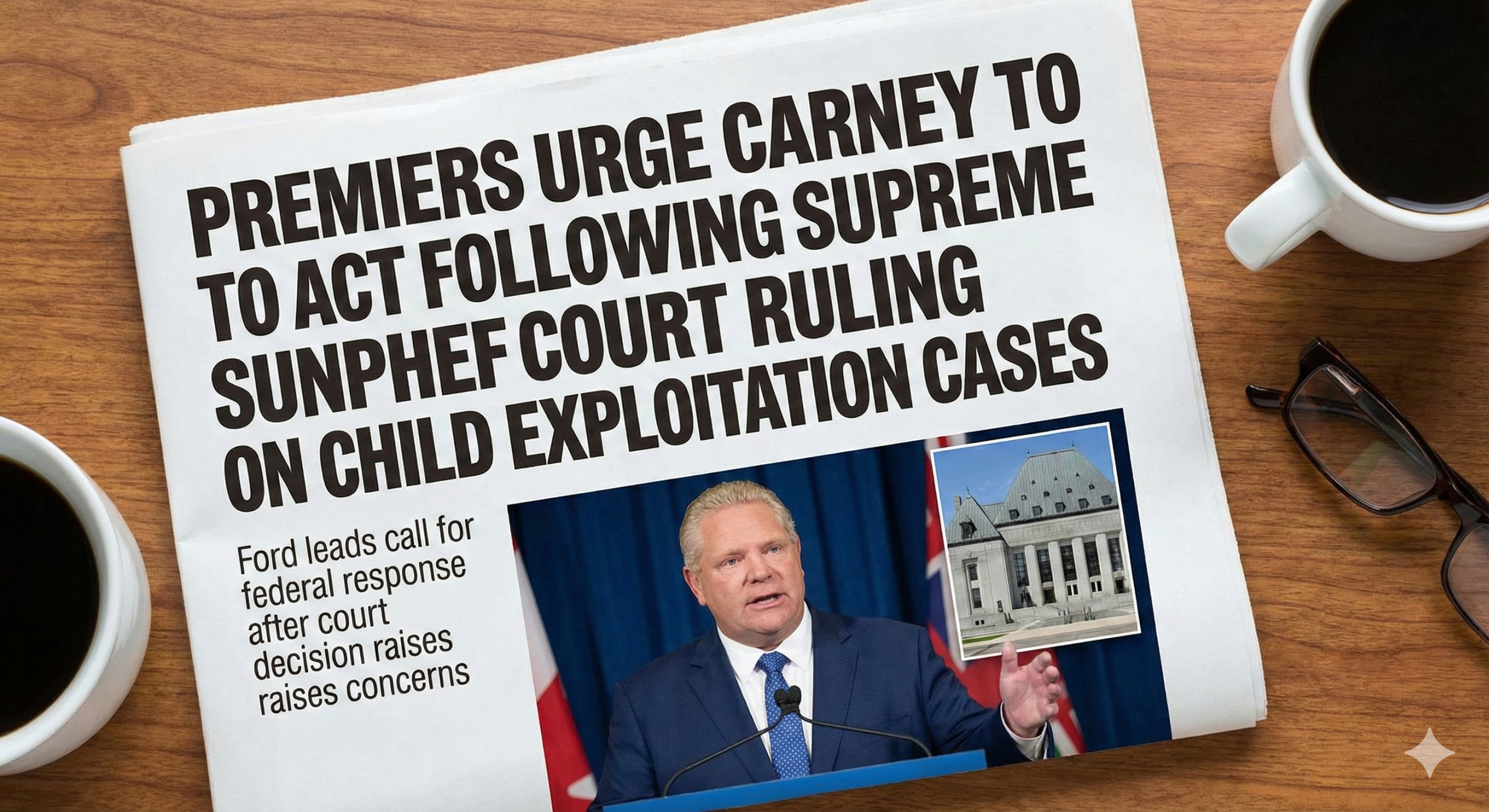
Growing Political Pressure After Landmark High Court Decision in Canada
Canada is witnessing an intense political and legal debate following a controversial ruling by the Supreme Court of Canada that struck down mandatory minimum jail sentences for certain child exploitation offences, particularly those relating to the possession and accessing of illegal child sexual abuse material. The ruling has triggered strong reactions from several provincial premiers, opposition leaders, and justice advocates who are now urging Prime Minister Mark Carney to take decisive action.
At the centre of the controversy is the court’s 5-4 decision declaring that the one-year mandatory minimum sentence for specific offences involving child pornography violates the Canadian Charter of Rights and Freedoms. The judges reasoned that such rigid sentencing removes judicial discretion and could lead to unconstitutional outcomes in rare or exceptional cases.
While the court emphasized that it is not minimizing the seriousness of these crimes, its decision has ignited concern among political leaders who argue that removing mandatory jail time sends the wrong message and weakens deterrence.
Premiers Demand Use of the ‘Notwithstanding Clause’
Several provincial leaders, including Ontario Premier Doug Ford, Alberta Premier Danielle Smith, and Conservative opposition leader Pierre Poilievre, have called on Prime Minister Mark Carney to invoke Section 33 of the Charter — commonly known as the “notwithstanding clause.” This clause allows governments to override certain constitutional rights for a limited period of time when deemed necessary.
Premier Doug Ford was particularly vocal in his condemnation of the Supreme Court ruling, describing the offence as one of the most disturbing crimes imaginable. He argued that individuals involved in the creation, distribution, or possession of such material should face strict and unavoidable jail time.
Ford stated that the courts had stepped outside the expectations of ordinary Canadians and insisted that Parliament must step in to protect vulnerable children and uphold public confidence in the justice system.
Manitoba Premier Sparks Controversy With Strong Remarks
Manitoba Premier Wab Kinew also echoed calls for harsher sentencing but drew backlash for the tone and intensity of his comments. While stressing that crimes involving child sexual abuse are among the most severe violations of human rights, Kinew’s statements were criticized for appearing to promote punitive rhetoric rather than constructive legal reform.
The Criminal Defence Lawyers Association of Manitoba condemned his remarks, asserting that such language from a public official inflames emotions and undermines the principle of balanced justice. The association reminded the public that the justice system must remain rooted in proportionality, due process, and constitutional safeguards.
Nova Scotia and Other Provinces Join the Call for Action
Nova Scotia’s Justice Minister Scott Armstrong announced plans to engage directly with federal officials in Ottawa. He emphasized the importance of restoring firm sentencing that deters offenders and reassures victims and their families that justice is being served.
Armstrong stated that strong penalties are essential not only for punishment but also for preventing future crimes and reinforcing the seriousness with which Canada treats child exploitation offences.
Support for stricter sentencing has also come from other provincial representatives who believe the federal government must respond swiftly to public outrage and perceived gaps in the criminal justice system.
Legal Experts Defend Supreme Court’s Position
Despite political backlash, many legal scholars and constitutional experts have defended the Supreme Court’s reasoning. They argue that mandatory minimum sentences can lead to unjust outcomes, especially in complex or rare scenarios where personal circumstances significantly affect culpability.
Wayne MacKay, a law professor from Dalhousie University, explained that the court is not condoning the crime but ensuring that penalties align appropriately with specific case details. According to MacKay, the principle that punishment must fit the crime is fundamental in Canadian law.
Experts also note that the ruling does not eliminate prison sentences; instead, it restores a judge’s ability to determine whether incarceration or alternative penalties are appropriate in each individual case.
Federal Government Rejects Use of Override Clause
Prime Minister Mark Carney’s Liberal government has firmly stated that it will not invoke the notwithstanding clause to overturn the Supreme Court’s ruling. Federal Justice Minister Sean Fraser clarified that while the government takes child exploitation seriously, it will seek solutions that uphold constitutional values.
Fraser explained that Ottawa is exploring alternative approaches such as strengthening investigative capabilities, improving digital crime enforcement, and enhancing victim support services, rather than bypassing the constitution.
The government believes that respecting judicial independence and constitutional limits is crucial for maintaining the integrity of Canada’s democratic institutions.
Public Reaction and National Debate Intensify
The ruling has sparked widespread discussion across the country, with citizens, advocacy groups, and media outlets weighing in on the balance between protecting children and preserving civil liberties.
Many parents and child welfare organizations argue that strict jail sentences are essential to safeguard minors from exploitation. Others warn that emotional responses should not drive laws that may unintentionally weaken judicial fairness.
This national conversation has highlighted deeper questions about the role of punishment, rehabilitation, and legal discretion in Canada’s justice system.
Understanding the Notwithstanding Clause
The notwithstanding clause was designed as a constitutional compromise, enabling legislatures to override certain rights for up to five years. It has historically been used sparingly and remains a politically sensitive tool due to its implications for civil liberties.
While some leaders view its use as necessary to correct judicial overreach, others fear it could erode the separation of powers and set a dangerous precedent for future governance.
What Happens Next?
Although the federal government has declined to override the Supreme Court ruling, pressure continues to mount. Provinces may pursue independent policy adjustments, and Parliament could propose amendments that align sentencing laws with constitutional standards while addressing public concerns.
This evolving situation reflects a critical moment in Canadian politics where legal interpretation, public safety, and constitutional rights are converging in a high-stakes national conversation.
As debate continues, one reality remains clear: the protection of children and the fairness of the justice system will remain central priorities in shaping Canada’s legal future.
Leave a Reply