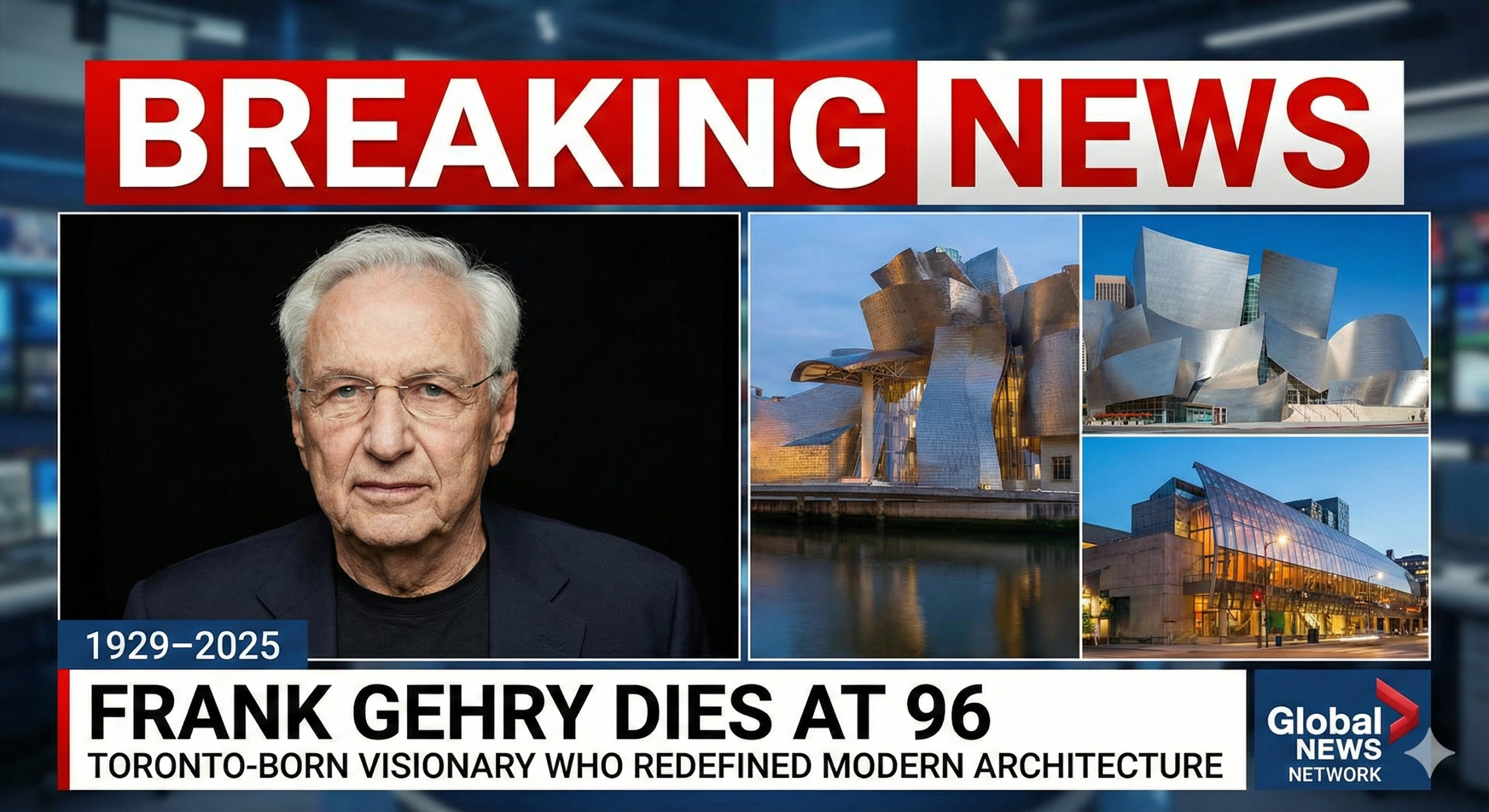
Introduction: A Trailblazer Whose Structures Changed the World
Frank Gehry, the groundbreaking architect whose daring imagination reshaped skylines across the globe, has died at the age of 96. Known for his sculptural, unconventional approach to design, Gehry transformed architecture into an expressive art form, pushing boundaries in ways few could imagine, let alone execute. From Toronto to Spain, California to beyond, his buildings stood as unmistakable signatures of originality and bold innovation.
Gehry passed away on Friday morning at his home in Santa Monica, California, after a brief illness, according to Meaghan Lloyd, chief of staff at Gehry Partners, LLP. His death marks the end of an extraordinary chapter in architectural history, yet his influence will continue to rise through the twisting steel, flowing glass, and daring silhouettes he left behind.
Gehry’s Most Recognizable Works: Icons of a Radical Vision
Throughout his remarkable career, Gehry designed some of the world’s most celebrated cultural, commercial, and institutional buildings. His work includes Toronto’s 2008 redesign of the Art Gallery of Ontario (AGO), Spain’s world-famous Guggenheim Museum Bilbao, the Walt Disney Concert Hall in Los Angeles, and Facebook’s headquarters in Menlo Park, California.
These structures were more than functional spaces — they were artistic statements. Often described as chaotic, futuristic, or defiant of traditional form, Gehry’s designs commanded attention and curiosity. His buildings did not simply blend in with the urban environment; they redefined it.
While other architects sought uniformity or classical symmetry, Gehry leaned into experimentation. Curves collided with jagged edges. Steel shimmered unnaturally under shifting sunlight. Walls bent where walls were never expected to bend. His creations forced people to stop, look, and reconsider what architecture could be.
Even outside professional circles, Gehry became a cultural icon. He was immortalized as a cartoon version of himself in an episode of The Simpsons, a rare honor that underscored how deeply his work had penetrated mainstream consciousness.
Inspiration and Early Influences in Toronto
A Childhood of Creativity Shaped by Family
Born Frank Owen Goldberg on February 28, 1929, in Toronto, Gehry was the child of Polish immigrant parents. His early life was deeply rooted in family, and it was his grandparents who would have the most lasting impact on his creative path.
His grandmother, Leah, played a particularly influential role. She would scatter bits of scrap wood — oddly shaped pieces from a nearby furniture shop — across her kitchen floor. She encouraged the young Gehry to arrange them into imaginary towns, bridges, and structures before placing the wood into the stove.
Years later, Gehry would reflect on those playful afternoons as the spark that ignited his lifelong passion. As quoted in the 2015 biography Building Art: The Life and Work of Frank Gehry by Paul Goldberger, he described the experience as “the most fun I ever had in my life,” realizing that it gave him “a licence to play.”
Those moments of unstructured creativity laid the foundation for an architect who would spend his career ignoring limits and embracing imagination.
Early Exposure to Architecture
As a teenager, Gehry attended Friday lectures at the University of Toronto, where he developed a fascination for speakers who challenged convention. He later came to believe that one such lecturer was Alvar Aalto, the acclaimed Finnish modernist architect known for breaking architectural rules and blending natural elements with functionality.
This early admiration for unconventional thinking shaped Gehry’s approach to design, reinforcing his belief that architecture could be emotional, expressive, and disruptive in the best possible way.
A New Life in the United States
Relocation to Los Angeles
In 1947, Gehry moved with his family to Los Angeles. Although Toronto shaped his early identity, it was the sprawling urban canvas of Southern California that would ultimately allow his career to flourish. He became a U.S. citizen three years later and began pursuing a formal education alongside his creative experimentation.
During his early years in the United States, his life was far from glamorous. By day, he worked as a truck driver. At night, he took sculpture classes at a local school. His determination eventually led him to earn an architecture degree from the University of Southern California.
His path was anything but linear, reflecting the same unpredictability found in his designs.
Personal Struggles and Name Change
In the mid-1950s, Gehry changed his last name from Goldberg, a decision influenced by concerns raised by his first wife. She feared the family’s Jewish surname might expose their children to antisemitism. Though Gehry later expressed regret over changing his name, it marked another turning point in a life shaped by circumstance and compromise.
Those early years were financially challenging. He juggled ambition with responsibility, struggling to support his family while trying to break into the architectural world. He briefly served in the U.S. Army and later studied urban planning at Harvard University before deciding to leave the program.
Despite the instability, these experiences forged his resilience — a quality that would define his long and sometimes controversial career.
Facing Criticism and Standing Firm
Throughout his life, Gehry faced harsh criticism for his designs. His unconventional forms were often misunderstood or dismissed as impractical, chaotic, or visually jarring. Yet he accepted criticism as a normal part of his profession.
In 2012, while presenting an early concept for a trio of proposed condominium buildings in Toronto, Gehry addressed his critics openly. He recalled the skepticism surrounding the Guggenheim Museum in Bilbao, Spain, a project that was once so unpopular it provoked intense hostility.
“In Bilbao, Spain, they wanted to shoot me when they saw the design,” he said. “Now they get $500 million a year in revenue to the city.”
He also remembered how the Walt Disney Concert Hall in Los Angeles had once been mocked as resembling “broken crockery.” Over time, however, that same building became one of the city’s most beloved landmarks.
For Gehry, ridicule was temporary, but artistic integrity was permanent.
The Toronto Connection: A Lasting Influence on His Hometown
Despite spending most of his professional life in the United States, Gehry maintained a strong connection to Toronto. His redesign of the Art Gallery of Ontario in 2008 stands as one of the city’s most significant architectural transformations.
The structure’s sweeping wooden staircase, dramatic glass façade, and thoughtful integration of old and new elements created a space that is both modern and deeply respectful of its surroundings. It remains a point of pride for the city and a testament to Gehry’s enduring bond with his birthplace.
Additionally, a trio of proposed condominium towers in Toronto’s entertainment district reflected his ongoing interest in shaping the city’s skyline. Though they faced public criticism and underwent design changes, the project underscored his lasting relevance in Canadian architectural discourse.
A Relentless Drive To Keep Creating
Even in his later years, Gehry refused to slow down. In a 2017 conversation with CBC Radio’s Ideas, he reflected openly on aging and mortality, yet emphasized his determination to keep working.
While others might have chosen retirement, Gehry remained deeply engaged with his craft. Design, to him, was not simply a profession — it was his reason for living.
That unrelenting drive, combined with a fearless approach to originality, is what allowed him to remain relevant across multiple generations of architects.
Conclusion: A Legacy Written in Steel, Glass, and Courage
Frank Gehry’s passing at 96 marks the end of a revolutionary life, but his legacy will endure in the physical form of the cities he helped reshape. His architecture challenged norms, stirred debate, and inspired countless artists, designers, and dreamers to take creative risks.
From a boy playing with wooden scraps on a Toronto kitchen floor to a global icon who redefined modern design, Gehry’s life was a testament to imagination, perseverance, and the power of unconventional thinking.
Though the man is gone, his buildings — bold, twisting, gleaming — will continue to speak for him. They will stand as monuments not only to his genius, but to the idea that art and architecture can be limitless when fear is left behind.
Leave a Reply