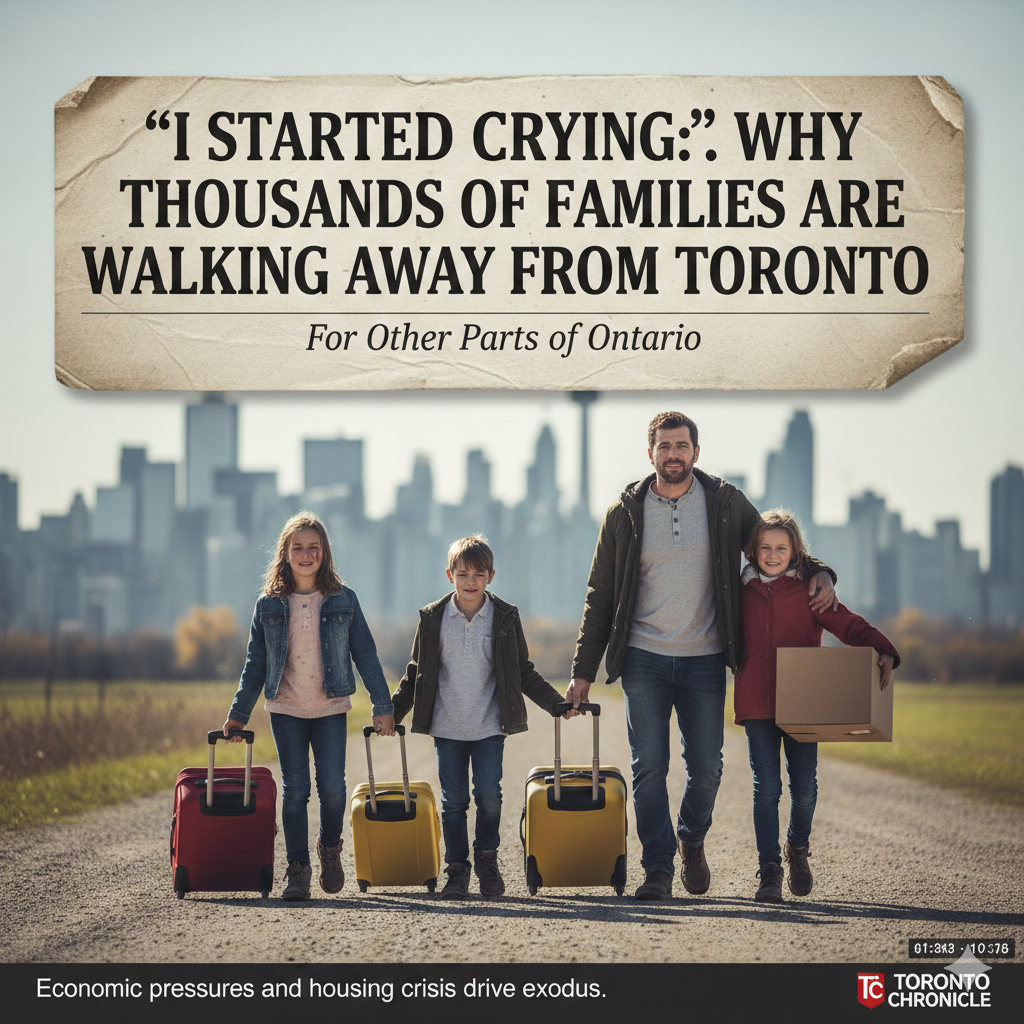
Toronto has long been promoted as the place where opportunity lives — a city of careers, diversity, and upward mobility. For many families, that promise was the reason they moved to the Greater Toronto Area (GTA) in the first place. But for a growing number of residents, reality has started to look very different.
According to new data from Environics Analytics, more than 35,000 households left the GTA in the past year alone, relocating to other regions across Canada. A large proportion of those families stayed within Ontario, choosing areas such as Simcoe County, Hamilton, and smaller communities like Chatham and London.
What was once considered a temporary trend connected to the pandemic is now revealing itself as a longer-term shift. Families are not simply moving away for more space — they are leaving because the city has become increasingly difficult to live in, raise children in, and plan a future within.
This is the second part of an ongoing series examining where Toronto residents are going and, more importantly, why they are making the decision to leave.
When a Six-Figure Income Still Isn’t Enough
Andrea Griffith believed that earning a combined household income of $200,000 a year would secure a comfortable life in Toronto. With a stable career, a supportive partner, and a newborn daughter, she assumed she could finally step out of the rental cycle and own a modest home.
She quickly discovered that assumption was wrong.
Just weeks after giving birth at the age of 43, Griffith and her family were forced to vacate the basement apartment they had been renting in Scarborough. Although they qualified for a mortgage of up to $750,000, the search for a suitable home in the city painted a harsh reality: the homes in that price range were often small, outdated, or far from the lifestyle they hoped to create for their child.
“On paper, it looked like we could afford to stay,” she said. “But in real life, it would have meant huge financial stress. I knew we would end up ‘house poor.’”
The term “house poor” is now common among Toronto residents — referring to people who spend such a high percentage of their income on housing that they have little left for savings, childcare, transportation, or emergencies. For a new family, this risk felt unacceptable.
Ultimately, Griffith and her partner made a difficult choice: they left the city and moved more than 300 kilometres southwest to Chatham, Ontario. There, they were able to purchase a detached home with breathing room in their budget — something that felt impossible in Toronto.
Financially, the move brought relief. Emotionally, it was far more complicated.
“I started crying because my daughter won’t have anyone at her second birthday,” Griffith admitted. “We don’t know anyone here. We left our entire support system behind.”
Even so, she is confident the decision was the right one.
“If renting in Toronto had been more affordable and more secure, we probably would have stayed longer,” she said. “But we couldn’t keep living on the edge.”
Safety Concerns Push Parents to Reconsider City Living
For other families, money is only part of the problem. Personal safety — or the lack of it — has become an equally powerful reason to leave.
Dustin Titus, 43, lived in South Etobicoke’s Long Branch neighbourhood with his family. One ordinary afternoon, while his young son was riding a balance bike, the boy veered dangerously close to the street. The moment was brief, but its impact was lasting.
“That scared me more than anything else,” Titus explained. “It made me realize just how vulnerable we were. You feel exposed in the city these days.”
Beyond traffic concerns, Titus described a growing discomfort with what his family encountered daily: speeding vehicles, heavy congestion, visible drug use in public spaces, and a general sense that things were becoming less controlled, especially for young children.
Eventually, they made the decision to relocate to Horseshoe Valley in Oro-Medonte, a small community in Simcoe County. What they found there stood in sharp contrast to their Toronto experience.
“Within three days of moving in, every neighbour had come over to introduce themselves,” he said. “We felt welcomed immediately — like we were part of something, not just living beside strangers.”
The ability to walk his children to school without fear and to see them play outdoors freely gave Titus a sense of peace he had not felt in years.
“It just feels natural here,” he added. “And when you have a family, that sense of normalcy is priceless.”
School Access Becomes a Breaking Point
For Morley Abbott, 39, the driving factor behind his family’s decision was education.
He and his wife live in North York, directly across from one of the area’s top-rated elementary schools. They assumed their daughter would eventually attend that school. However, a recent adjustment in school zoning boundaries meant that their home would no longer be included in the school’s catchment area. Instead, their daughter would be required to travel several kilometres away by bus to a different school.
While the change may sound minor, it forced the family into a difficult moment of reflection.
“We love our neighbourhood,” Abbott said. “But suddenly we were asking ourselves a bigger question: If our child can’t even attend the school across the street, then why are we staying here at all?”
The change acted as a catalyst. After weighing their options, the family decided to move to London, Ontario — a city where their daughter will be able to attend school alongside her cousins and remain close to extended family.
“It feels like families like ours are being forgotten in big cities,” Abbott said. “The system doesn’t seem designed to support us.”
Experts Say the Trend Is Long-Standing — and Growing
Urban planning expert Matti Siemiatycki, director of the University of Toronto’s Infrastructure Institute, says the movement away from the GTA has been happening for years. The difference now is the speed and scale of the shift.
“When you combine the cost of housing, the challenges of finding childcare, and ongoing issues with school access, it becomes clear why families start looking elsewhere,” he explained. “Every neighbourhood has its own challenges, and people are simply choosing places where life feels more manageable.”
The migration data confirms this. While some families are moving to other provinces, many are choosing smaller cities and towns within Ontario that offer a lower cost of living, a calmer environment, and better access to community resources.
What was once considered a “downgrade” from the big city is now seen as a lifestyle upgrade.
City Officials Respond to Growing Out-Migration
Toronto officials are not ignoring the issue.
In a statement, the office of Mayor Olivia Chow acknowledged the seriousness of the situation and outlined steps being taken to make the city more affordable. The city is working on increasing housing supply, strengthening renter protections, and supporting the construction of deeply affordable housing units.
According to the mayor’s office, 25,000 new homes are expected to break ground this year and next, many through city-led or city-supported initiatives. Officials say the goal is simple: people who work and study in Toronto should be able to live in Toronto.
However, not everyone is convinced that current efforts will be enough.
City Councillor Brad Bradford described the mass departure of residents as a genuine crisis.
“When tens of thousands of people are leaving your city every year, that’s a warning sign,” he said. “If 60 per cent of your workforce talked about quitting, the alarm bells would be ringing. This is no different.”
A City at a Crossroads
Toronto remains Canada’s largest economic hub, attracting skilled workers, students, and immigrants from around the world. Yet, as housing prices rise, neighborhoods become more crowded, and services are stretched thin, more families are left asking themselves a painful question: Is staying really worth it?
For people like Andrea Griffith, Dustin Titus, and Morley Abbott, the answer was no.
They did not leave in search of luxury — they left in search of stability, safety, and a future that felt possible.
As thousands more families consider making the same choice, the city finds itself at a critical turning point. Without meaningful change, Toronto risks becoming a place people come to work — but no longer stay to build a life.
Leave a Reply