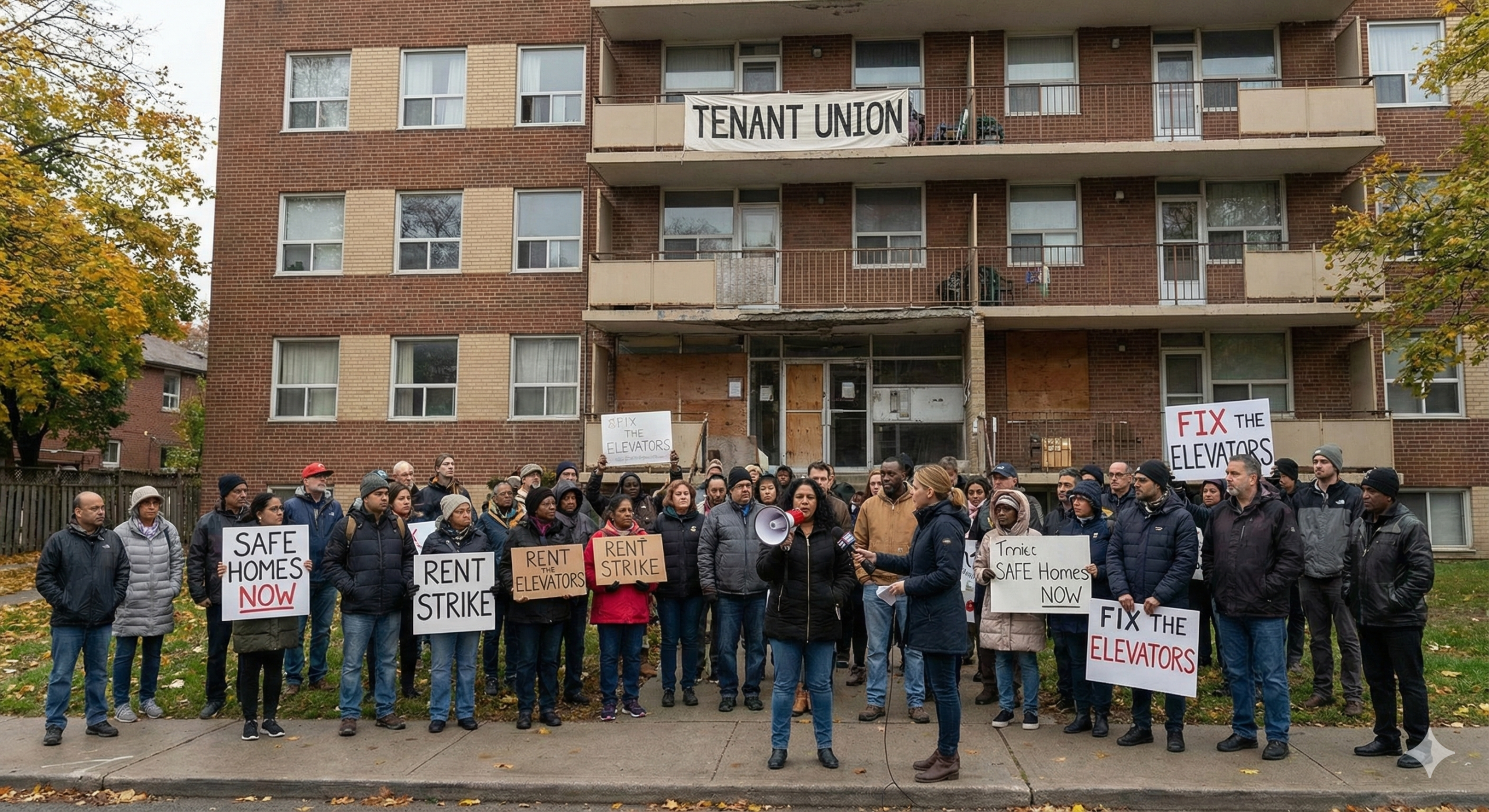
EAST YORK, TORONTO — Tenants at a long-troubled apartment building in East York are escalating their fight for safe and livable housing, demanding significant rent refunds and ongoing rent reductions as they continue to endure what they describe as years of neglect, unsafe conditions, and repeated failures by their landlord to address serious maintenance issues.
Residents of the apartment complex at 500 Dawes Road say the building has deteriorated to a point where daily life has become increasingly difficult and, in some cases, unsafe. With concerns ranging from rodent infestations to structural damage, tenants have now turned to collective legal action in hopes of forcing accountability and meaningful change.
Years of Complaints, Little Resolution
Tenants report that problems at the building are not new. Many say they have been raising concerns for years, only to see little improvement despite repeated complaints to property management and the city.
Among the most serious issues cited are persistent rodent infestations, crumbling ceilings, and balconies showing visible signs of structural decay. Residents describe conditions that have worsened over time, contributing to anxiety, health concerns, and a sense of insecurity within their own homes.
“These are not cosmetic issues,” said one tenant, who asked not to be named. “We’re talking about problems that affect our safety and our ability to live with dignity.”
Collective Legal Action Through the Landlord and Tenant Board
Frustrated by the lack of progress, tenants have now taken a significant step forward. With the assistance of legal counsel, residents have filed two multi-tenant applications against their landlord with Ontario’s Landlord and Tenant Board (LTB).
The applications represent dozens of tenants acting together rather than as individuals, a move advocates say strengthens their case and highlights the systemic nature of the issues within the building.
H3: Rent Refunds and Future Abatements Sought
Tenant advocate Ryan Endoh, who has emerged as a leading voice for residents, says the applications seek substantial financial remedies.
“We’re looking to get about 40 to 60 per cent of the rent that tenants have paid over the past year refunded,” Endoh explained. “We’re also asking for a 40 to 60 per cent rent abatement going forward, along with damages and other remedies.”
Endoh says the goal is not only compensation but also pressure — pressure on the landlord to finally bring the building up to acceptable standards.
A History of City Enforcement Orders
City records show that the property’s problems are well-documented. The building’s owner, Carolyn Kreb, has been the subject of repeated enforcement action over the years.
According to former Toronto city councillor Janet Davis, the landlord has received more than 80 property violation orders over the past decade, many of which remain unresolved.
“There are 84 orders currently outstanding, and within those orders are thousands of individual violations,” Davis said. “That tells you just how extensive and persistent the problems are.”
Despite fines and enforcement notices issued by the city, tenants say the conditions inside the building have remained largely unchanged.
City Hall Attention and a Promise of Action
The situation at 500 Dawes Road gained broader attention this past summer when Mayor Olivia Chow visited the building, meeting with tenants and touring the property to see the conditions firsthand.
Following that visit, Chow pledged to explore what is known as remedial action — a measure that allows the city to step in, complete necessary repairs using hired contractors, and then recover the costs by adding them to the landlord’s property taxes.
For tenants, the promise offered a glimmer of hope after years of frustration.
H3: Delays Add to Tenant Frustration
However, that hope has been tempered by delays. According to Endoh, tenants were initially told they would receive an update on remedial action by the end of 2025. That timeline has now been pushed back to 2026.
“It’s difficult,” Endoh said. “It puts tenants in a very challenging position. We’re doing what we can, but there’s clearly a disconnect between policy and implementation.”
The delay means tenants must continue living with unresolved issues while waiting for both city intervention and a legal hearing.
Calls for Stronger Enforcement Tools
Former councillor Janet Davis says the situation highlights broader gaps in how municipalities enforce housing standards against problematic landlords.
Chow previously indicated that city staff would be tasked with advising council on how best to legally enforce remedial action in cases like this one.
“I hope and trust that when the next report comes back, there will be real teeth in this remedial action,” Davis said. “These housing problems need to be fixed, and the cost should be added to the taxes of this and other bad landlords across Toronto.”
Advocates argue that without swift and decisive enforcement, some landlords simply factor fines into the cost of doing business while tenants continue to suffer.
Long Waits at the Landlord and Tenant Board
Compounding tenants’ frustration is the reality of Ontario’s overburdened Landlord and Tenant Board system. Residents have been told it could take up to a year before their applications are heard.
During that time, tenants remain responsible for paying full rent unless interim relief is granted, even as conditions persist.
Housing advocates say delays at the LTB disproportionately affect tenants in situations like this, where safety and habitability are at stake.
Impact on Health and Well-Being
Tenants say the building’s conditions have taken a toll not just physically, but emotionally and mentally as well.
Rodent infestations raise concerns about sanitation and disease. Structural deterioration creates fear about potential injuries. For families with children or seniors, the stress is especially acute.
“People feel ignored,” said one tenant. “It’s exhausting to keep complaining and feel like nothing changes.”
Attempts to Contact the Property Owner
CityNews attempted to contact the property owner, Carolyn Kreb, for comment on the allegations and legal action but was unable to reach her.
Without direct communication from ownership, tenants say they feel shut out of any meaningful dialogue about repairs or timelines.
A Broader Housing Conversation
The situation at 500 Dawes Road has become emblematic of larger challenges facing renters in Toronto, where demand for housing is high and affordable options are limited.
Tenant advocates argue that the fear of losing housing often discourages renters from speaking out, allowing substandard conditions to persist unchecked.
“This isn’t just about one building,” Endoh said. “It’s about how we protect tenants across the city and ensure that housing is safe, dignified, and properly maintained.”
What Comes Next
For now, tenants await two parallel processes: a hearing date at the Landlord and Tenant Board, and clarity from the city on whether and when remedial action will be taken.
Until then, residents say they will continue documenting issues, supporting one another, and pushing for accountability.
While the legal road ahead may be long, tenants at 500 Dawes Road say they are determined to see it through — not only for themselves, but for others facing similar conditions across Toronto.
As one tenant put it, “We’re not asking for luxury. We’re asking for safe homes. That shouldn’t be too much to demand.”
Leave a Reply