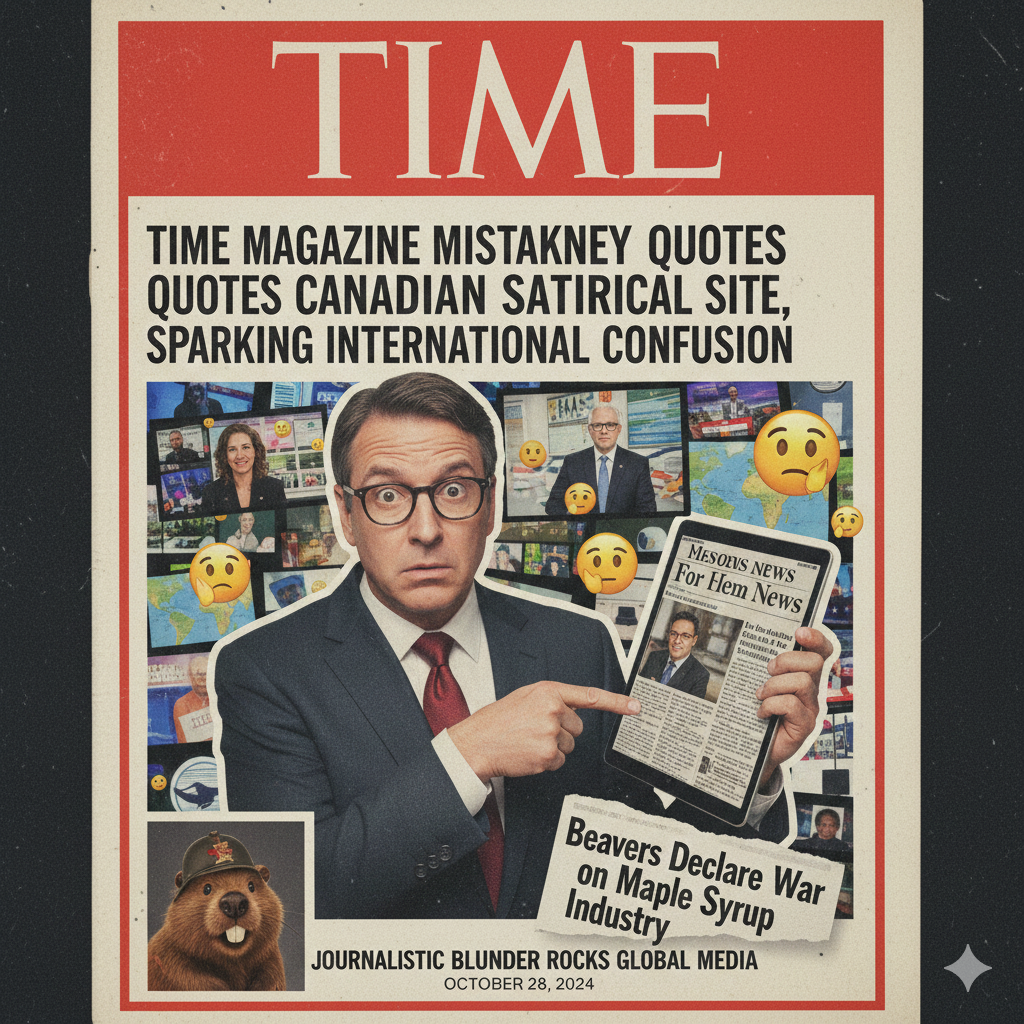
A major editorial blunder recently unfolded when Time magazine mistakenly treated a satirical quote from a Canadian parody website as a real statement, highlighting the growing challenges news organizations face in verifying information in a digital and increasingly automated media environment. The incident involved a fabricated remark attributed to the U.S. Ambassador to Canada, Pete Hoekstra, which was originally created by the Canadian satire outlet The Beaverton.
The error not only misrepresented a high-ranking diplomat but also reignited debates around fact-checking standards, satire recognition, and the role of artificial intelligence in modern journalism.
How a Satirical Quote Found Its Way Into a Global Publication
The confusion stemmed from a recent Time magazine article discussing strained diplomatic and trade relations between the United States and Canada. In the piece, Time referenced an event hosted by the Halifax Chamber of Commerce, where Ambassador Pete Hoekstra reportedly expressed frustration over Canada’s role in American politics and trade negotiations.
Among the alleged quotes was an aggressive and alarming statement suggesting Canada could be targeted with extreme consequences:
“A Canada that it would be very easy to target with 500% steel tariffs, or one patriot missile aimed at Parliament Hill.”
This dramatic quote, attributed to Hoekstra in Time’s original article, was completely fabricated. In reality, the statement had been created by writers at The Beaverton, a well-known Canadian satirical and parody publication similar in style and intent to the American outlet The Onion.
Hoekstra never made the remark.
The Beaverton: A Satirical Publication Meant to Entertain, Not Deceive
The Beaverton is recognized for publishing fictional, comedic stories inspired by real-world events. Its content is deliberately exaggerated to satirize political, social, and cultural developments. The website includes a disclaimer explaining that when real individuals or organizations are named, the details of the story are entirely fictional.
The controversial quote in question originated from a satirical article titled:
“U.S. Ambassador threatens to tariff, annex, and bomb Canada if anti-American sentiment doesn’t improve.”
According to Ian MacIntyre, a writer at The Beaverton, the quote was “entirely made up” and contained “no grain of truth whatsoever.” MacIntyre confirmed to CTVNews.ca that the article was purely comedic in nature and never intended to be misinterpreted as a factual report.
He stated that he believed the exaggerated tone of the satire would make the joke obvious to readers.
“I thought it would be very clear that what we wrote was a complete joke,” he said. “Apparently, Time magazine did not see it that way.”
Two Months of Confusion Before a Correction Was Issued
The satirical article was originally published in September and remained online for several months. Despite its fictional nature, the invented quote somehow made its way into Time’s reporting and was treated as a legitimate diplomatic threat.
It took nearly two months for the error to be discovered and publicly addressed. On Friday, Time finally issued a correction at the end of the original article, acknowledging the mistake:
“The original version of this story incorrectly attributed a quote from a satirical site to Pete Hoekstra, the U.S. Ambassador to Canada.”
While the correction clarified the situation, the delay raised serious questions about editorial oversight at major media organizations.
Clare Blackwood, an actor, comedian, and writer at The Beaverton, called the situation “wild” and somewhat unbelievable.
“For two months, people thought that the United States might shoot a patriot missile at Parliament Hill — and nobody raised the alarm,” she said, half in disbelief.
Concerns Over Fact-Checking and the Role of AI in Journalism
Beyond the embarrassment of the simple mistake, the incident has drawn attention to deeper concerns within the journalism industry, particularly regarding research methods and source verification.
Blackwood questioned how such an error could happen inside a respected media organization.
“What kind of research went into this? How did they end up using a satirical quote from The Beaverton?” she asked.
MacIntyre also raised the possibility that artificial intelligence or automated tools may have played a role in gathering or summarizing information used by the reporter.
“I don’t know if that’s what happened,” he said carefully. “But it certainly makes you wonder. Time never reached out to us for clarification, so it’s hard to know exactly how the quote ended up in their story.”
AI-powered tools are increasingly used in newsrooms to speed up research, summarize topics, and even write draft content. However, this case highlights how dangerous automation can become when not paired with human verification and traditional journalistic standards.
A History of Satire Being Mistaken for Reality
This is not the first time that The Beaverton has seen its fictional content misinterpreted as factual reporting. According to MacIntyre and Blackwood, multiple publications over the years have cited their satirical articles without realizing that they were written as jokes.
While satire has long served as a powerful tool to comment on politics and society, its lines can blur in today’s fast-moving information cycle, especially on social media where articles are often shared without context.
“We’re trying to write the most obviously ridiculous stories we can,” MacIntyre said. “We’re poking fun at the news, not trying to fool anyone. That’s never been our goal.”
Still, the fact that a respected international publication failed to recognize satire has intensified concerns about how easily misinformation — even unintentional — can spread across borders.
The Real-World Impact of a Simple Error
Although the situation may appear humorous on the surface, attributing violent or hostile language to a diplomat carries serious geopolitical implications. In an era of tense international relations and ongoing trade disputes, inaccurate reporting can inflame tensions, mislead the public, and undermine trust in both governments and media institutions.
Blackwood shared that she wished, if a mistaken quote was going to be used, it had been taken from a less sensitive or less inflammatory article.
“I would have preferred it was one of our more harmless jokes,” she said. “Something that didn’t have potential global consequences.”
The situation has forced conversations about the responsibility of major publications to verify every quote — no matter how believable it may seem or where it is sourced.
A Wake-Up Call for the Media Industry
In response to the incident, media analysts and journalists alike are now reinforcing the importance of critical reading, multiple-source verification, and human editorial oversight.
While parody and satire serve valuable purposes in society, this case proves that the distinction between fact and fiction can easily disappear when editorial standards slip. In a media environment where speed often takes priority over accuracy, even the most trusted publications risk damaging their credibility.
As for The Beaverton, its contributors maintain that satire will always be part of their mission — but they hope news organizations will exercise greater caution moving forward.
“We’re here to make people laugh and think,” MacIntyre added. “We never imagined one of our jokes would end up in Time as real diplomatic commentary. But here we are.”
Conclusion: A Lesson in Media Literacy and Accountability
The Time magazine misquote stands as a powerful example of why strong fact-checking and media literacy are more important than ever. In an age where information spreads within seconds and algorithms often decide what is seen, the responsibility of journalists, editors, and readers to verify sources has never been greater.
What began as a satirical joke ended as an international reporting error — one that took two months to correct. For many, the incident is both a cautionary tale and a reminder: even the most established publications are not immune to mistakes.
As the media industry continues to evolve alongside technology, the line between satire and fact must be guarded with care, precision, and accountability — because the consequences of crossing it can reach far beyond a simple joke.
Leave a Reply