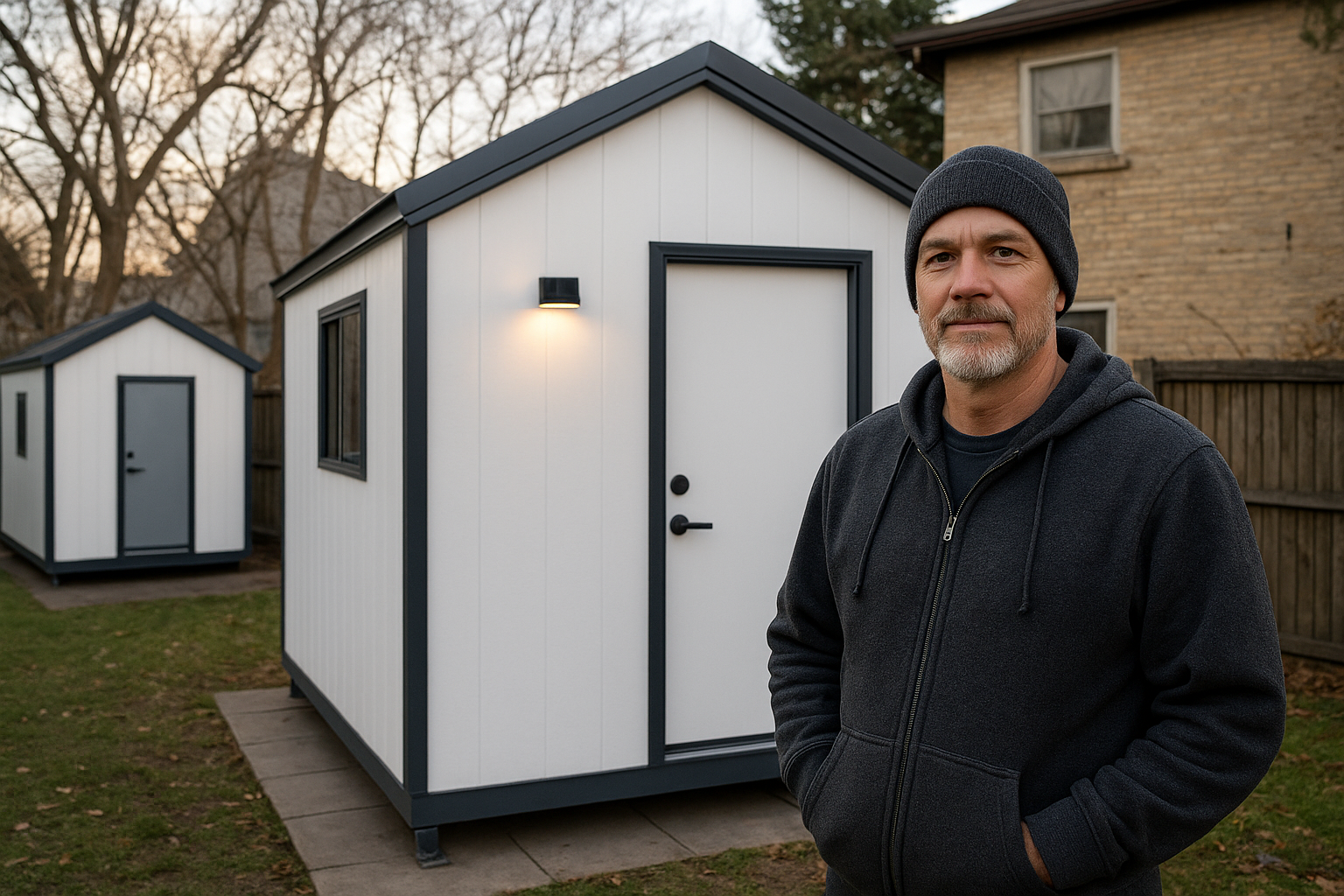
As winter tightens its grip on Toronto, a familiar figure in the city’s grassroots housing movement is once again stepping in where gaps persist. The builder behind the tiny mobile homes that briefly occupied St. James Park has introduced a new set of micro-shelters—this time on private property in Leslieville—continuing his mission to provide immediate, safe refuge for people experiencing homelessness.
For at least one resident, the impact has been profound.
“It saved my life,” said Paul Corbett Greer Jewell, a 65-year-old man who recently moved into one of the compact shelters. After years of living on the streets and cycling through overcrowded shelters, Jewell says the tiny home has given him stability, safety, and hope for the future.
A Fresh Start After Years Without Stable Housing
Jewell is one of the first occupants of four newly built micro-shelters installed in the backyard of Lazarus House, an emergency transitional housing site in Leslieville operated by the Seeds of Hope Foundation. The charitable organization supports individuals who are unable to secure shelter beds and face the risk of sleeping outdoors.
“A Home Base” in the Middle of Winter
For Jewell, the shelter represents far more than a roof overhead.
“It’s a safe, warm place for me, with locks and everything else, and security so I can go out and look for jobs and get myself back in order,” he said. “It’s a really great transitional thing. It’s a home base.”
After spending years exposed to the dangers of street life, Jewell says the ability to lock his door and sleep without fear has been transformative. The shelter allows him to focus on rebuilding his life rather than simply surviving day to day.
Builder Continues Work Despite Past City Intervention
The micro-shelters are the latest project by Ryan Donais, founder of the non-profit organization Tiny Tiny Homes. Donais previously gained attention for placing five tiny mobile homes in Toronto’s St. James Park, near King Street East and Jarvis Street, to house people living outdoors.
From Public Park to Private Property
Those units were eventually removed after the City of Toronto issued a cease-and-desist order. Donais worked with city officials to ensure each resident was transitioned into permanent housing before relocating the structures. The original units were moved to Lazarus House, and newer, updated models have now taken their place on the property.
Despite the earlier pushback, Donais says his core mission has not changed.
“It’s cold out, and you get people indoors,” he said. “The purpose of Tiny Tiny Homes is to get people off the street and into a tiny home, and then transition them into permanent housing. It’s a stepping stone. It’s not a solution.”
A Transitional Model, Not a Permanent Fix
Donais has consistently emphasized that micro-shelters are not meant to replace long-term housing strategies. Instead, they are designed as an immediate intervention—providing warmth, safety, and stability while residents work toward permanent accommodation.
Collaboration With the City Still the Goal
Donais says he remains open to collaboration with municipal authorities and hopes his work can complement broader housing efforts.
“We’ve been in some collaborative conversations with the city,” he said. “We want to work with the city, and we want to get more people housed.”
He added that every effort has been made to comply with existing rules and reduce potential risks associated with the shelters.
Inside the Leslieville Micro-Shelters
The four micro-shelters installed at Lazarus House are modest in size but intentionally designed for comfort and safety.
Compact, Insulated, and Code-Compliant
Each unit measures approximately 48 square feet—large enough to accommodate a bed and a small shelving unit. Built using refrigeration panels for insulation, the shelters are equipped with wall sconces, smoke detectors, and 1,000-watt heaters to maintain warmth during freezing temperatures.
According to Donais, the shelters meet Ontario Building Code standards, and their electrical systems have been inspected by the Electrical Safety Authority.
“We’ve done absolutely everything to make sure we mitigate risk and play within the rules,” he said, noting that the city has not yet raised concerns about the new installations.
CBC Toronto has contacted the City of Toronto for comment regarding the shelters but had not received a response as of publication.
Support From the Property Owner and Local Charity
The micro-shelters are located on property rented by the Seeds of Hope Foundation, whose leadership has publicly backed the initiative.
A Safe and Supportive Environment
Kimberly Curry, executive director of Seeds of Hope Foundation, said the property’s landlord supports the presence of the tiny homes. While the shelters do not currently have formal city permits, Curry noted they are built on wheels and can be moved if required.
“To the city, I would say, let’s work together,” Curry said.
She believes the shelters fill a critical gap, particularly for individuals who struggle to access traditional shelter spaces.
“What the tiny homes do is provide someone with security—because your things are locked—warmth, and love when it’s in a community,” she said.
Access to Essential Services
Residents of the micro-shelters are not isolated. The Seeds of Hope Foundation provides access to shared amenities within Lazarus House, including bathrooms and kitchen facilities.
Food and Community Support
In addition, food from the foundation’s four pop-up food banks is delivered weekly, ensuring residents have reliable access to meals. Curry says the combination of shelter, services, and community support can make a meaningful difference in helping people stabilize their lives.
She added that after observing Donais’s efforts and the challenges he encountered, the foundation decided to step in and help make the project viable.
“The essence of what he was doing was not getting caught up in reasons why it couldn’t be done,” Curry said. “He was focused on getting it done—and we said, ‘We’re here for you. We’re going to do this.’”
Expanding the Vision for Tiny Housing
Donais’s work is not stopping with the current models. He is already developing a larger version of the tiny home that includes a sink and enough space to accommodate a couple or a small family.
Looking Ahead to Broader Solutions
While he acknowledges that micro-shelters alone cannot solve Toronto’s homelessness crisis, Donais believes they play an important role—especially during winter months when the risk of harm is highest.
For residents like Jewell, the impact is immediate and deeply personal. The shelter has given him a sense of safety and dignity that had been missing for years.
“It’s given me a chance,” Jewell said.
Conclusion: Small Shelters, Significant Impact
As Toronto continues to grapple with a persistent housing crisis, initiatives like the Leslieville micro-shelters highlight both the urgency of the problem and the creativity of grassroots responses. Though temporary by design, the tiny homes offer more than warmth—they provide stability, security, and a crucial bridge toward permanent housing.
Leave a Reply